Interactive companion to the systematic review of generative AI in teachers’
instructional design. All five figures are driven by the study-level coding data
(225-11-4 LLM final.xls) and reproduce the counts in the Results draft exactly.
Hover any study in Figs. 2–4 — the same study lights up in all three, with its full coding profile
in a tooltip. Use the chips above to isolate a TAPA configuration.
Fig. 1 · PRISMA study selection Methods §3
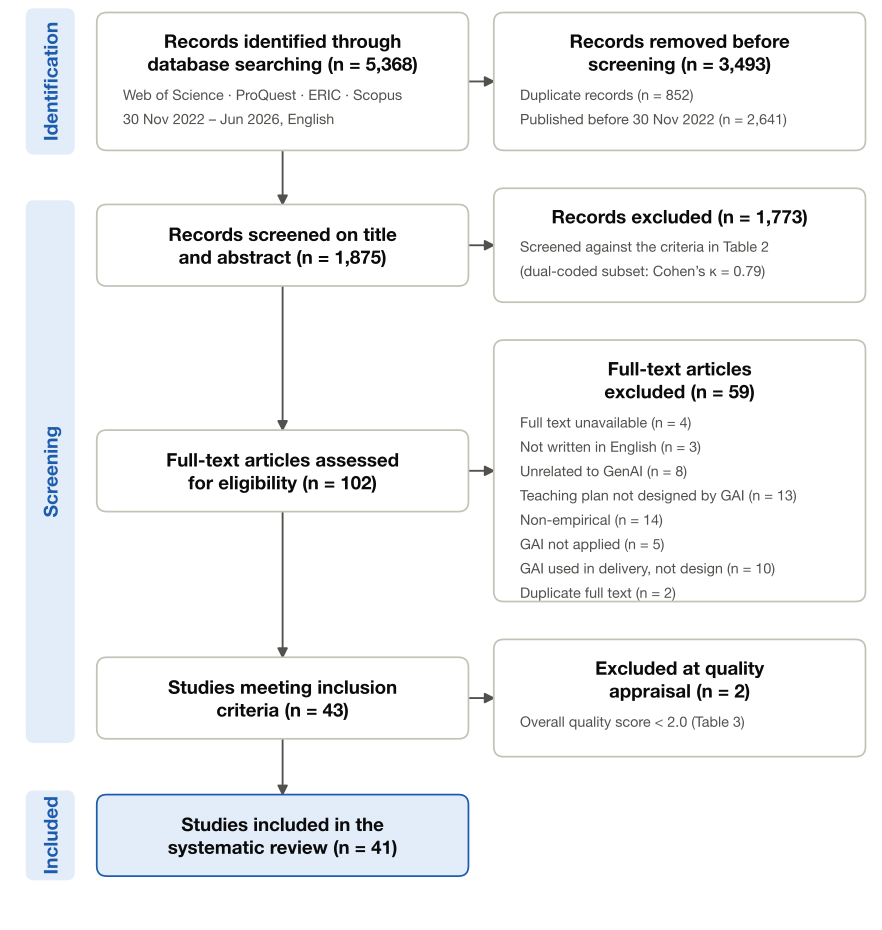
PRISMA flow diagram of the study selection process: 5,368 records identified; 3,493 removed before screening (852 duplicates, 2,641 published before 30 Nov 2022); 1,875 screened on title/abstract; 102 assessed in full text; 59 excluded with reasons; 2 removed at quality appraisal; 41 studies included. Requested in ChenMY’s Methods comment; drawn with the 59-item exclusion breakdown so that all stage totals reconcile (102 − 59 = 43; 43 − 2 = 41).
Fig. 2 · Evidence map of all 41 studies RQ1 · transparency
Coding profile of the 41 included studies, grouped by TAPA configuration. Dots = GAI affordances coded; colored strips = SAMR and AI-TPACK levels; letters = pedagogical knowledge emergence and teacher–AI relationship; bars = affordances per study.
What it shows
- The dot cloud thins toward the right-hand columns (adaptation support, process support, closed-loop feedback) — the RQ1 underutilization finding made visible.
- The SAMR strip darkens from C1 to C3, showing the configuration–transformation association.
- Every study’s full coding is exposed, so the figure doubles as a transparency device — every claim in the Results can be audited against it.
Passages this figure carries
Results §4.2.1 — “The most frequently coded affordance was Search and analyze information, present in 32 of 41 studies (78.0%)…”
Results §4.2.1 — “On average, each study coded 4.3 distinct GAI affordances (range = 2–7), with the majority of studies (n = 36, 87.8%) engaging three or more affordances simultaneously.”
Results §4.2.1 — “…the distribution is highly skewed toward basic and core design functions, with adaptation support, process support, and closed-loop feedback being significantly underutilized.”
Fig. 3 · The alignment space RQ2
Distribution of the reviewed studies (N = 40; one study not classifiable on SAMR) in the space defined by cognitive integration breadth (AI-TPACK) and pedagogical practice depth (SAMR). Dot color = TAPA configuration; dot size = number of distinct GAI affordances (2–7).
What it shows
- Necessary but not sufficient. Almost all studies sit in the AI-TPACK row (35/41), yet they spread across the full SAMR range — high cognitive integration does not guarantee transformation.
- The Augmentation–Modification massif. The field concentrates at AI-TPACK × Augmentation (14) and AI-TPACK × Modification (16), straddling the Enhancement/Transformation divider.
- The empty frontier. The Redefinition column holds a single outlier (Hemminki-Reijonen et al., 2025) — visually motivating the call for deeper teacher–GAI partnerships.
Passages this figure carries
Introduction §1 — “The cognitive breadth of AI-generated artifacts, specifically the extent to which they integrate technological, pedagogical, and content knowledge, is fundamentally associated with their pedagogical depth.”
Results §4.3.1 — “…while high-level TPACK integration is a necessary condition for transformational practice, it is not sufficient, as some AI-TPACK studies remained at Augmentation or Substitution levels.”
Results §4.2.2 — “A single study (2.4%) reached the Redefinition level (Hemminki-Reijonen et al., 2025), in which GAI enabled the creation of entirely new learning experiences through immersive, AI-mediated role-playing scenarios that were previously inconceivable.”
Fig. 4 · Pathways of teacher–AI partnership RQ3a · RQ3b
Each thread is one study. Hover a thread to trace its full pathway; hover a dark node to highlight its members.
Alluvial diagram of teacher–AI partnership pathways: teacher role → GAI role → relational structure → SAMR empowerment level, colored by TAPA configuration.
What it shows
- The four TAPA configurations appear as literal braided streams — the green Transformational braid (Design planner → Creative partner → Co-creation) lands predominantly on Modification, while the blue Content-production braid terminates at Augmentation.
- One-study-one-thread keeps the small categories (Teaching expert, Critical review loop, N/A) honestly visible instead of vanishing into aggregate ribbons.
Passages this figure carries
Results §4.4.4 — “…the Command-output mode was concentrated at the lower end of the SAMR spectrum: Augmentation (n = 7, 63.6%) and Modification (n = 4, 36.4%), with no studies reaching Redefinition.”
Results §4.4.4 — “…the teacher’s role as orchestrator, rather than commander, is a key enabler of deeper pedagogical transformation through GAI collaboration.”
Results §4.5 — “The analysis reveals four distinct configurations of human-AI pedagogical alignment, each characterized by a specific constellation of teacher roles, AI roles, and relational structures…”
Fig. 5 · The TAPA framework Results §4.5
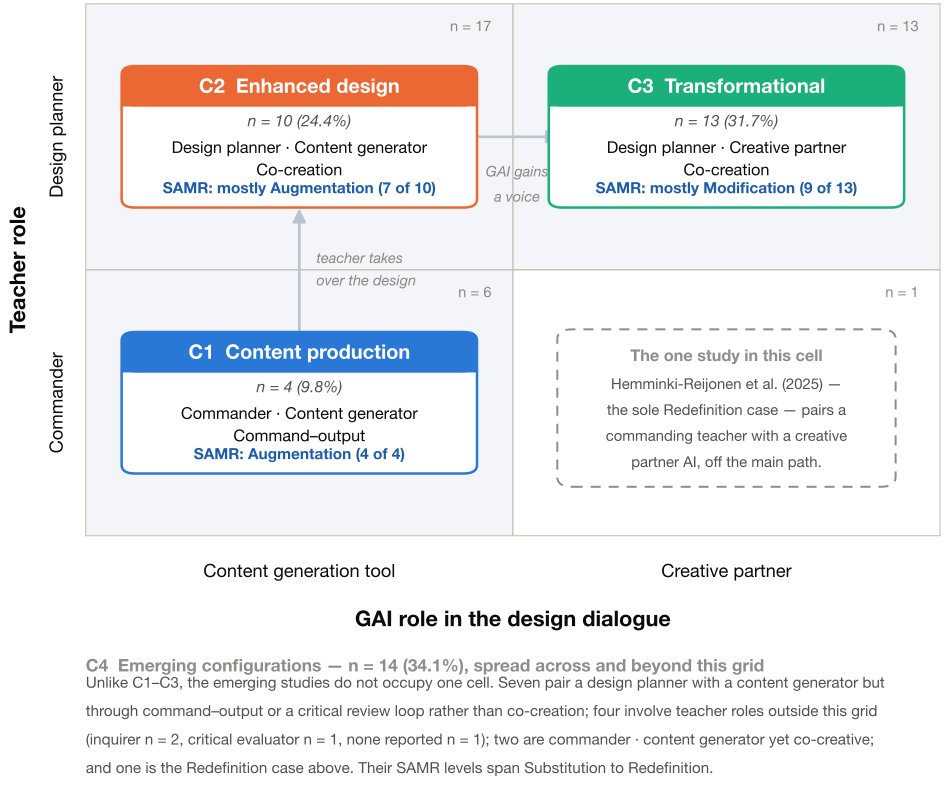
The TAPA (Teacher–AI Pedagogical Alignment) framework. Configurations C1–C3 are positioned on the two coded role dimensions and form a stepped developmental path: the teacher first assumes design authorship (C1 → C2), after which the GAI acquires a genuine voice (C2 → C3). Each card names the relational structure and the modal SAMR level of its studies. The single Redefinition study occupies the remaining cell, off the main path.
What it shows
- The theoretical distillation of Fig. 4: where the alluvial shows the 41 empirical pathways, this diagram states the model — a stepped path in which the teacher first takes over design authorship (C1 → C2), and only then does the GAI gain a voice in the dialogue (C2 → C3).
- Why stepped, not diagonal. A diagonal was drafted first and abandoned: C2 and C3 share the identical teacher role (Design planner) and differ only in the GAI role, so raising C3 above C2 would assert a difference in teacher agency the coding does not contain.
- The honest grid surfaces something the diagonal hid: the Commander × Creative partner cell holds exactly one study — Hemminki-Reijonen et al. (2025), the sole Redefinition case — sitting off the main developmental path.
- Per ChenMY’s comment, all three dimensions are encoded: teacher role (y-axis), GAI role (x-axis), relational structure (named on each card). 2D rather than literal 3D for print legibility.
Passages this figure carries
Results §4.5 — “Collectively, these four configurations suggest a developmental trajectory in teacher-GAI partnerships, from using GAI as a content production tool (Configuration 1), to engaging it as a design assistant (Configuration 2), to collaborating with it as a creative partner (Configuration 3), with emerging configurations (Configuration 4) pointing toward yet more sophisticated forms of human-AI co-creation.”